When someone opens a website today, the first impression is not the design or the text - but the Security.
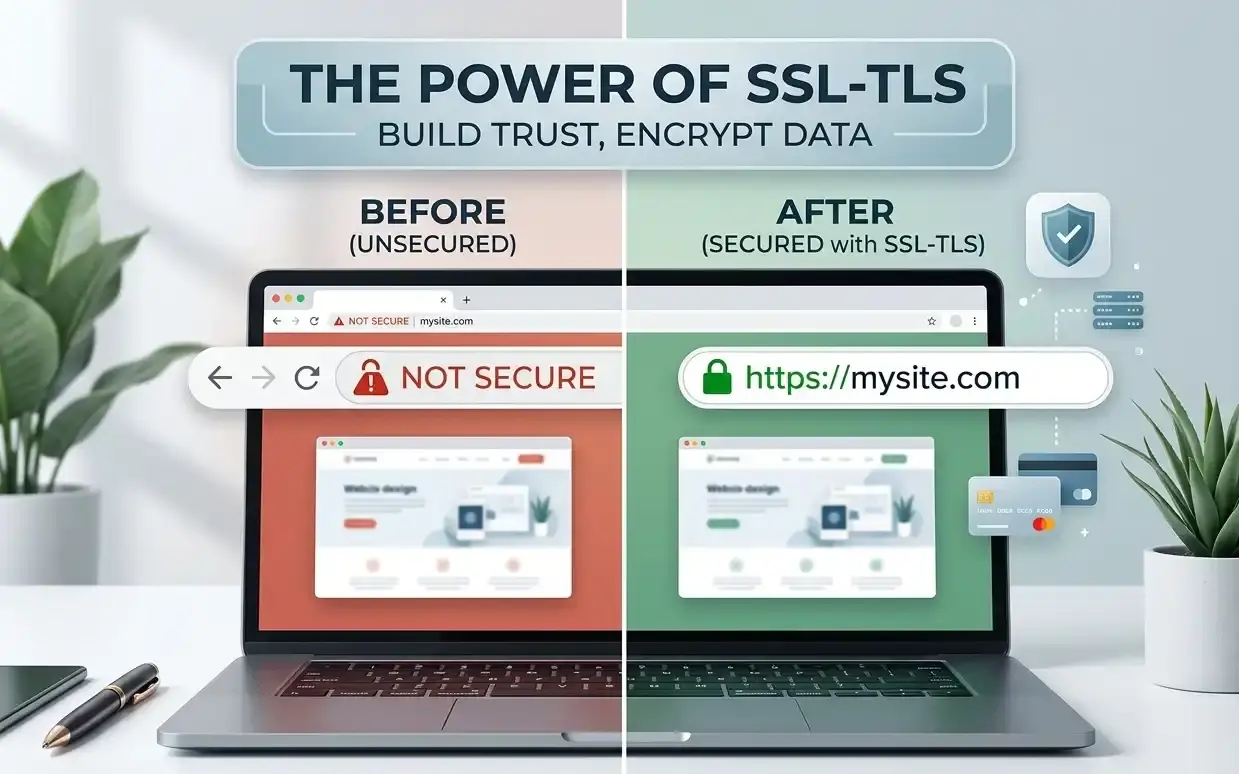
If the browser says
„Not safe”,
a significant proportion of visitors will close the page immediately.
And that's where the SSL certificate comes in (short for Secure Sockets Layer).
What is SSL (and what is HTTPS)?
The SSL certificate (now actually TLS - Transport Layer Security) encrypts the data traffic between the user and the website.
This is what appears in your web address:
https://
This means:
✔ data is encrypted,
✔ they cannot be easily intercepted,
✔ secure communication.
What happens without SSL?
Without SSL, your website is like sending a postcard in the post: anyone can read it on the go.
Specific risks:
- data theft (e.g. passwords, email addresses),
- credit card data leaks,
- interception of forms,
- easier execution of hacker attacks.
For example, if you have:
- your contact form,
- your webshop, or
- your login system,
you are taking a serious risk without SSL.
Effect of the „Not Safe” label
Browsers (e.g. Chrome) will clearly indicate if there is no SSL:
- „Not safe”,
- red warnings,
- blocked functions.
What does this mean in practice?
- visitors do not trust you,
- they do not send a message,
- do not buy,
- they leave the site.
Google and SEO: ranking behind without SSL
A Google and other search engines officially treat HTTPS as a ranking factor.
This means:
- Without SSL you get lower rankings in search engines,
- fewer visitors,
- the reversal rate increases.
In other words, not just security, but a business issue.
When is SSL mandatory?
In short: MINDIG.
But especially if:
- you have a webshop,
- request data (form),
- appointment booking works,
- customer contact is made on the site.
In 2026, a website without SSL will be not a professional website.
Good news: it's not expensive (and often free)
Today it is:
- many hosting providers gives you SSL for free,
- Activated with 1-2 clicks,
- is automatically renewed most of the time,
so there is no excuse for missing out.
Summary
An SSL certificate is not an extra - it's a standard.
If not:
❌ loss of confidence,
❌ data security risk,
❌ SEO disadvantage, and
❌ loss of revenue.
If available:
✔ security,
✔ credibility,
✔ better Google rankings, and
✔ more customers.
If you see an „unsafe” warning on your site, sign up for an free consultation - We'll talk through the problem and I can help you fix it if you want.